
NIS2 implementation: how to efectively manage compliance and incident reporting
Implementing NIS2 is neither a technology project nor a one-off compliance exercise. Above all, it represents a fundamental shift in how an organisation manages cybersecurity..
This new approach spans processes, roles, and management decisions. It also requires organisations to be operationally prepared to respond to incidents. Companies must therefore address not only technology, but also procedures and accountability structures.
NIS2 further reinforces the role of the board in cybersecurity governance. As a result, every organisation must clearly define who makes decisions and who is responsible for incident response.
NIS2 as a management system — not a one-time project
The most common mistake organisations make is treating NIS2 as a checklist to "tick off". The directive, however, demands a continuous and documented approach to security management.
Effective NIS2 implementation must therefore be embedded within the organisation's existing governance framework and include:
- clear assignment of responsibilities,
- formal decision-making processes,
- periodic risk assessments,
- control and continuous improvement mechanisms.
How to govern NIS2 within your organisation
1. Board engagement and oversight
NIS2 explicitly places accountability on senior management. In practice, this means:
- the board must approve the organisation's cybersecurity risk management approach,
- cybersecurity should be a standing item on the board agenda,
- decisions on IT and security investment must be made deliberately, based on risk.
Without genuine board engagement, NIS2 implementation will remain nothing more than documentation.
2. Roles and responsibilities structure
Effective NIS2 governance requires clearly defined roles, including:
- a cybersecurity owner (e.g. CISO or CIO),
- operational roles within IT and security teams,
- designated points of contact responsible for incident notification,
- cross-functional collaboration with legal, compliance, and business continuity teams.
Absent clear role definitions, delayed incident response becomes almost inevitable.
NIS2 implementation: a step-by-step approach
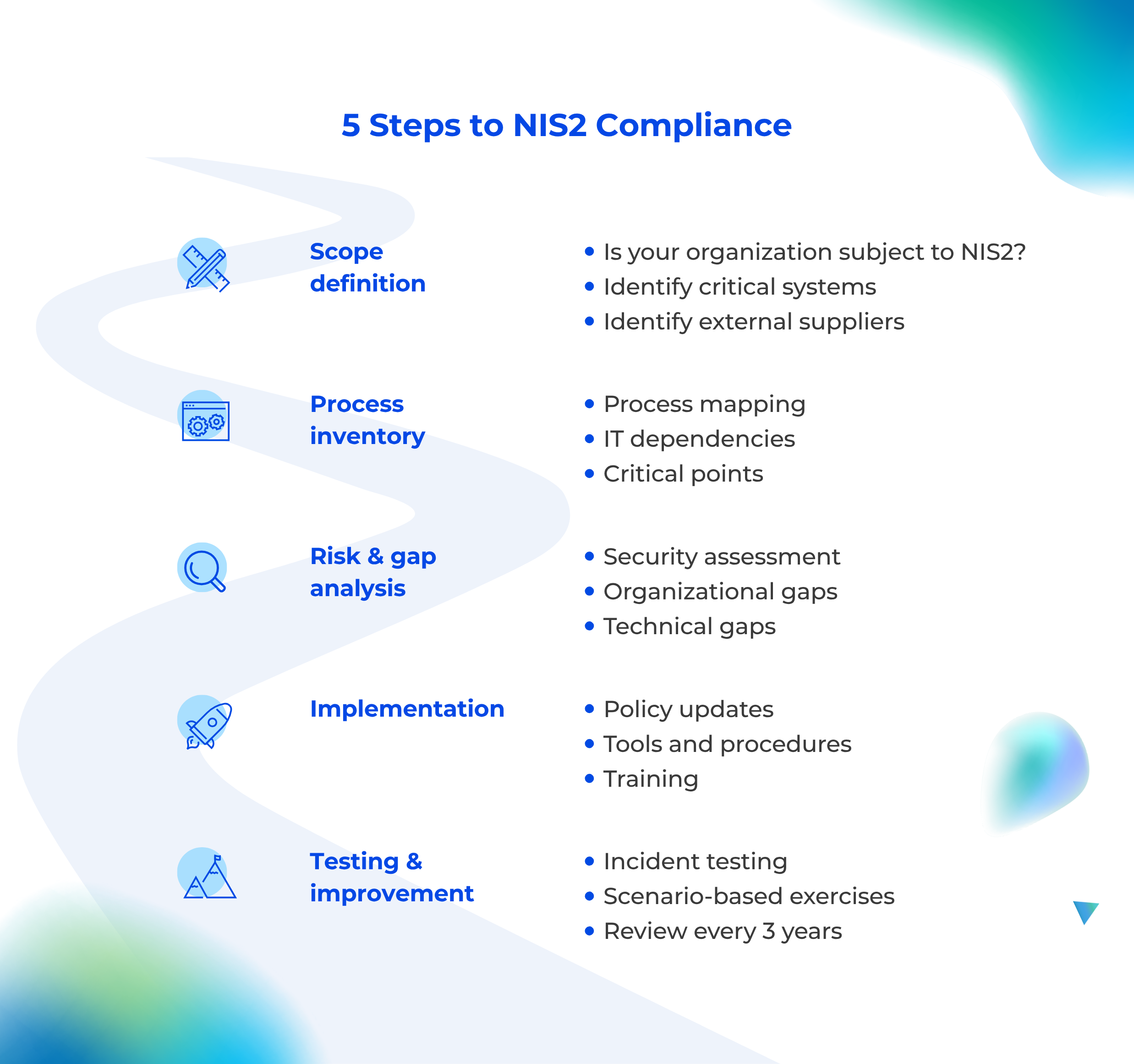
1. Scope definition
- determine whether the organisation falls within NIS2's scope,
- identify critical systems, services, and processes,
- account for third-party vendors and outsourced services.
2. Process mapping and inventory
- map business processes and the IT systems that support them,
- identify dependencies and single points of failure,
- assess the potential operational impact of an incident.
3. Risk and gap analysis
- evaluate the current state of security controls,
- benchmark the current posture against NIS2 requirements,
- identify organisational, process, and technical gaps.
4. Implement remediation measures
- update policies and procedures,
- implement or strengthen technical controls,
- deliver training for staff and senior management.
5. Testing and continuous improvement
- conduct incident response testing,
- run scenario-based exercises,
- perform regular reviews and updates.
Incident notification and reporting: a practical guide
One of the most demanding aspects of NIS2 is the obligation to report cybersecurity incidents within tight deadlines. Meeting these requirements demands preparation well in advance.
What constitutes a significant incident?
A significant incident is one that:
- causes or is likely to cause serious disruption to service delivery,
- affects the confidentiality, integrity, or availability of data or systems,
- may have material financial, operational, or reputational consequences.
Defining clear incident classification criteria before an incident occurs is therefore essential.
The incident reporting process
An effective process should include:
- rapid detection and logging of the event,
- internal escalation to designated roles,
- assessment of whether the incident meets the reporting threshold,
- preparation and submission of the notification to the competent authority.
Critically, the process must be simple, unambiguous, and validated through real-world testing.
NIS2 reporting timeline
NIS2 establishes a multi-stage reporting structure:
- initial notification within 24 hours,
- detailed report within 72 hours,
- final report upon closure of the incident (or every 30 days until resolution).
To meet these deadlines, organisations must have rapid access to up-to-date technical, operational, and business information at all times.
Common organisational challenges
In practice, organisations most frequently struggle with:
- unclear roles and accountability,
- fragmented knowledge of systems and processes,
- immature incident response procedures,
- insufficient testing and simulation exercises.
NIS2 exposes these weaknesses – but equally provides the impetus to address them.
Summary
Effective NIS2 implementation requires the integration of governance, process, and technology. Organisations that approach the directive strategically will achieve not only regulatory compliance, but also greater operational resilience and stronger cybersecurity risk control.
Ultimately, NIS2 is not merely an obligation – it is a maturity test for how well an organisation governs IT and security.
NIS2 isn't just a regulatory requirement – it's a risk your board owns. Let's make sure you have the right answers before your regulator asks the questions.
The administrator of the data entered in the form is Finture Ltd. Personal data will be processed to establish contact and answer questions. More information about your rights and data processing rules is available in the privacy policy.