What every CIO needs to know about NIS2?
NIS2 Directive fundamentally transforms the role of the CIO within an organisation. Cybersecurity is no longer purely an IT operational concern – it has become a matter of strategic accountability, subject to regulatory and board-level oversight. For CIOs, this means new responsibilities, but also a significantly stronger position within the organisational decision-making structure.
The CIO as a key compliance partner under NIS2
While NIS2 formally places accountability with the board of directors, in practice it is the CIO who becomes one of the primary architects of organisational compliance. The CIO holds critical knowledge of systems, technological dependencies, IT vendors, and real operational risks.
As a result, the CIO's role shifts from infrastructure management toward strategic functions:
- co-developing the organisation's cybersecurity risk management strategy,
- advising the board on technology-related decisions,
- coordinating IT, security, and business operations.
The scope of systems and services covered by NIS2
One of the CIO's first challenges is identifying which systems and services are critical under NIS2. The directive extends well beyond "core IT" – it encompasses all systems whose unavailability, integrity breach, or confidentiality failure could disrupt service delivery.
For CIOs, this requires:
- mapping IT systems to business processes,
- identifying critical dependencies and single points of failure,
- accounting for systems managed by third-party vendors (SaaS, cloud, outsourced services).
Risk management: beyond technical security
NIS2 mandates a risk-based approach to cybersecurity. CIOs must therefore move beyond classical infrastructure security and factor in:
- operational and business risks arising from IT incidents,
- supply chain dependencies,
- the impact of incidents on business continuity.
In practice, this demands close collaboration with compliance, legal, information security, and business continuity management teams.
Incident reporting obligations: operational readiness for IT
From a CIO's perspective, one of the most demanding aspects of NIS2 is the requirement to report significant incidents within very tight timeframes.
To meet these obligations, CIOs must ensure:
- continuous event and incident monitoring,
- clear criteria for classifying an incident as significant,
- escalation and internal communication procedures,
- the ability to deliver technical data within hours – not days.
Inadequate technical and process readiness can result not only in regulatory sanctions, but also in a serious erosion of board confidence.
IT vendor and cloud supply chain security
NIS2 substantially raises the bar for supply chain security. For CIOs, this translates into:
- assessing the security posture of key IT vendors,
- reviewing contracts for security and incident-related clauses,
- ensuring timely access to information in the event of a vendor-side incident.
In effect, the CIO becomes the owner of vendor relationships from a regulatory compliance perspective as well.
CIO's role in supporting board-level accountability
Although NIS2 places formal accountability with the board, the CIO serves as a critical advisor. Boards will expect CIOs to:
- translate technical risks into clear business language,
- provide the board with accurate, actionable information for decision-making,
- articulate the real-world consequences of underinvesting in cybersecurity.
For many organisations, this means rethinking how IT reporting is framed – moving from technical metrics to management-level insight.
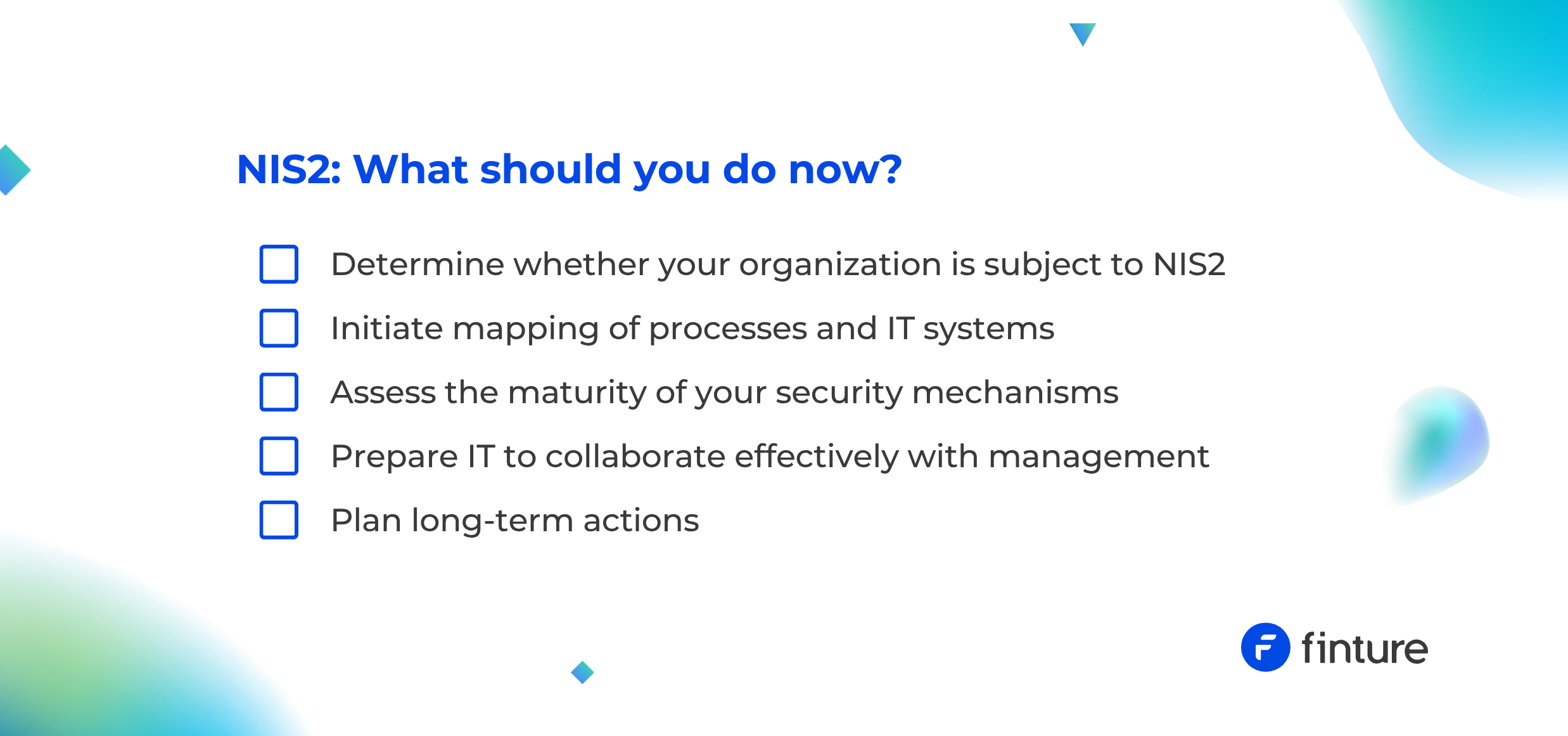
NIS2 action plan: what CIOs should do now
To achieve NIS2 compliance, CIOs should prioritise the following steps:
- confirm whether the organisation falls within the scope of NIS2,
- initiate a mapping of IT systems and business processes,
- assess the maturity of existing security controls,
- prepare the IT function for effective collaboration with the board and regulators,
- develop a long-term compliance roadmap – not merely a paper exercise.
NIS2 isn't just a regulatory requirement – it's a risk your board owns. Let's make sure you have the right answers before your regulator asks the questions.
The administrator of the data entered in the form is Finture Ltd. Personal data will be processed to establish contact and answer questions. More information about your rights and data processing rules is available in the privacy policy.