Analyst’s Perspective
3 Questions for the Expert. Mariusz Walasiewicz
How is artificial intelligence changing the everyday life of financial institutions? We talk with Mariusz Walasiewicz, a business and systems analyst who observes and co-creates AI implementations in banks, investment firms, and insurance companies. From his perspective, this is no longer about futuristic plans but a reality that already affects the quality of processes and decision-making across the entire sector.
Together with Mariusz, we explore where AI currently brings the greatest value in finance, while also examining the challenges, risks, and areas where the use of generative artificial intelligence requires particular responsibility.
Do you see opportunities for using generative AI within financial institutions?
Absolutely — and in fact, it’s not just a matter of opportunity, because this is already happening in the present. Generative artificial intelligence is now a real tool supporting processes in banks, insurance companies, and investment firms. From a financial institution’s perspective, the greatest advantage of GenAI is its ability to analyze massive volumes of data in real time. AI not only draws conclusions from historical data but also dynamically adapts to changing circumstances. This is key for financial areas such as algorithmic trading, liquidity management, and credit decision-making.
In other words, AI is not something that could be used in financial institutions — it’s already there. The real question is not whether to use AI, but in which areas of finance it can be applied wisely and responsibly.
The real challenge – and at the same time a major opportunity – will be uncovering less obvious use cases. This includes areas such as dynamic fraud detection and automated analysis of customer interactions. It also extends to optimizing back-office operations and supporting the management boards of financial institutions in making strategic decisions.
What threats do you see related to GenAI in financial institutions?
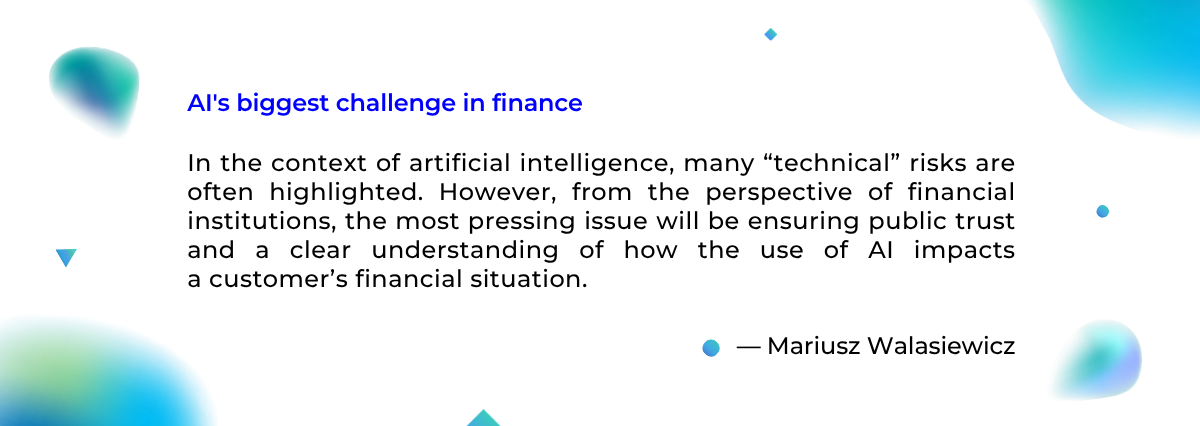
Every innovation involves risk — especially one as groundbreaking as artificial intelligence. The huge potential of AI comes with equally significant dangers, particularly in the context of financial institutions. Among the most common concerns I’ve encountered are algorithmic errors, hidden biases in data, lack of model transparency, and increased vulnerability to cyberattacks. These are important issues, but from my perspective, financial institutions should also focus on something else — something less technical but more fundamental: the risk of losing public trust in the financial system.
Finance is a trust-based sector. When customers do not understand decisions made by AI, it becomes a serious issue. Even more so when they feel the system is treating them unfairly or impersonally. If such situations are not addressed early, they can escalate into a trust crisis. Moreover, this crisis may affect not only GenAI, but also individual institutions – or even the financial system as a whole.
That’s why I believe it’s crucial that the implementation and development of generative AI solutions in the financial sector (and in every sector where public trust is fundamental, such as healthcare or energy) go hand in hand with investments in model transparency, client and community education, and clear communication about how AI systems make their decisions and on what basis.
Building early supervision mechanisms, performing regular audits, and testing models for bias can significantly reduce the risk of losing trust. Just as important will be investment in effective and transparent communication. Who knows — maybe through such efforts, artificial intelligence will actually help strengthen the credibility of the financial sector?
Are there areas where artificial intelligence benefits the work of an analyst?
An analyst’s role often involves working with massive amounts of documentation, data, dependencies, and requirements that can change on a daily basis. In this context, AI can be a real source of support. With AI-based tools, analysts can catch inconsistencies in documentation and analyze dependencies between system components much more efficiently.
Moreover, AI can also assist in the more “soft” aspects of the job — for example, summarizing meetings or processing user feedback. To sum up, artificial intelligence may make analysts faster and more effective, but also more focused on delivering value instead of just documents.