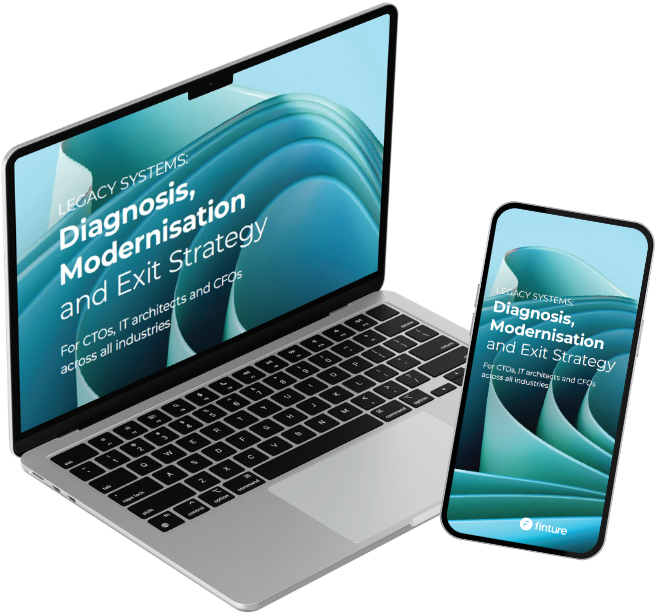
What is a legacy system and why do we call it that?
In many organizations, the word legacy triggers strong emotions. For some, it’s synonymous with “something old and problematic,” while for others, it’s a critical part of the business that simply has to work. To have a meaningful discussion about legacy systems, it’s worth starting with the basics: what they actually are and where the term comes from.
What is a legacy system?
A legacy system is an IT system that:
- was created in the past (often many years ago),
- is still used in everyday business processes,
- plays a key role in the organization’s operations,
- but no longer keeps pace with current technological or business needs.
One important point:
👉 Legacy does not automatically mean “bad” or “broken”.
In practice, these systems are often:
- stable,
- well-proven,
- responsible for critical processes (e.g., settlements, accounting, core operations).
The problem begins when maintaining or developing them becomes increasingly difficult.
Why do we call them “legacy”?
The word legacy means heritage – something passed down from the past.
In the context of IT, it’s a very fitting metaphor.
A legacy system is:
- the legacy of technological decisionsthat were once the best possible choices,
- the result of past business, regulatory, and organizational realities,
- the outcome of years of modifications, workarounds, and compromises.
No one built legacy systems expecting them to become a problem. On the contrary – at the time they were created, they were modern and effective.
When does a system become a legacy system?
There is no single time or technology threshold. A system does not become legacy simply because it:
- is “old”,
- runs on older technology,
- has been in the company for many years.
We start calling a system legacy when signals such as the following appear:
- Difficulty in development
Every change takes a long time, is expensive, and carries significant risk. - Lack of flexibility
The system does not support new business models, integrations, or automation. - Dependence on a small group of experts
Knowledge about the system exists in the heads of a few people (sometimes just one). - Out-of-mainstream technology
No vendor support, difficulty recruiting specialists, lack of updates. - Rising maintenance costs
The system “works” but it consumes more and more time, money, and energy to keep it running.
Legacy Documentation Automation
Knowledge about your
system architecture can update itself
Wiedza o architekturze systemu może aktualizować się sama
Instead of manually rewriting code structures and wasting time in Confluence, implement S*.doc.
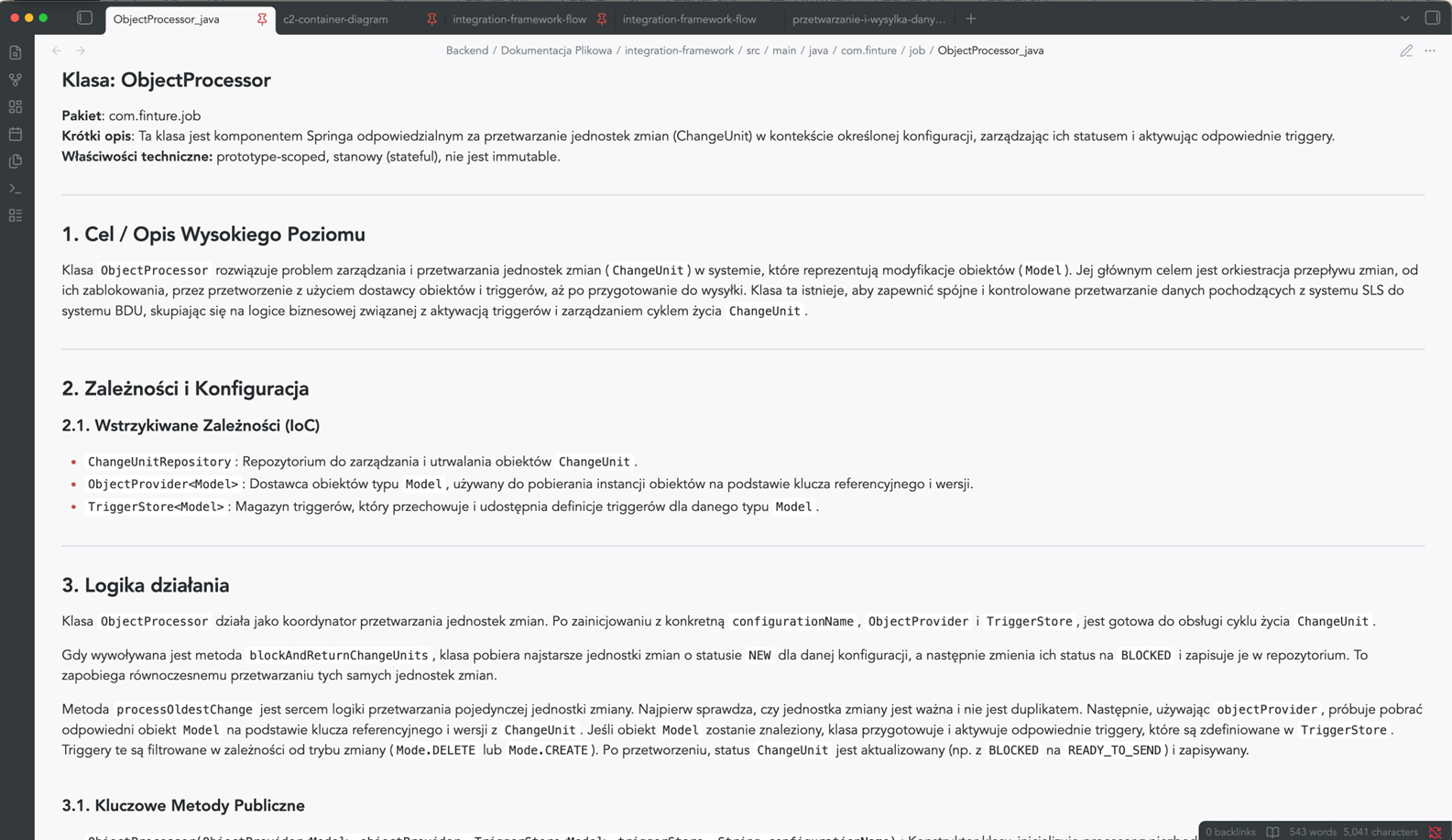
Our AI agents automatically map your application architecture, while your team gets a RAG bot integrated with Microsoft Teams that can answer any question about the system directly from the source code.
Automatic generation of Java/C# documentation
Code documentation
Generated automatically, taking into account the specific features of the programming language – Java, C#, TypeScript, C++. It divides the content into logical sections, omits irrelevant elements and allows you to tailor the type of documentation to the audience: technical for developers or simplified for end users.
- A clear, structured description of each module
- Automatic skipping of boilerplate and generated code
- The ability to generate a report on compliance with safety guidelines or a report on technological optimisation
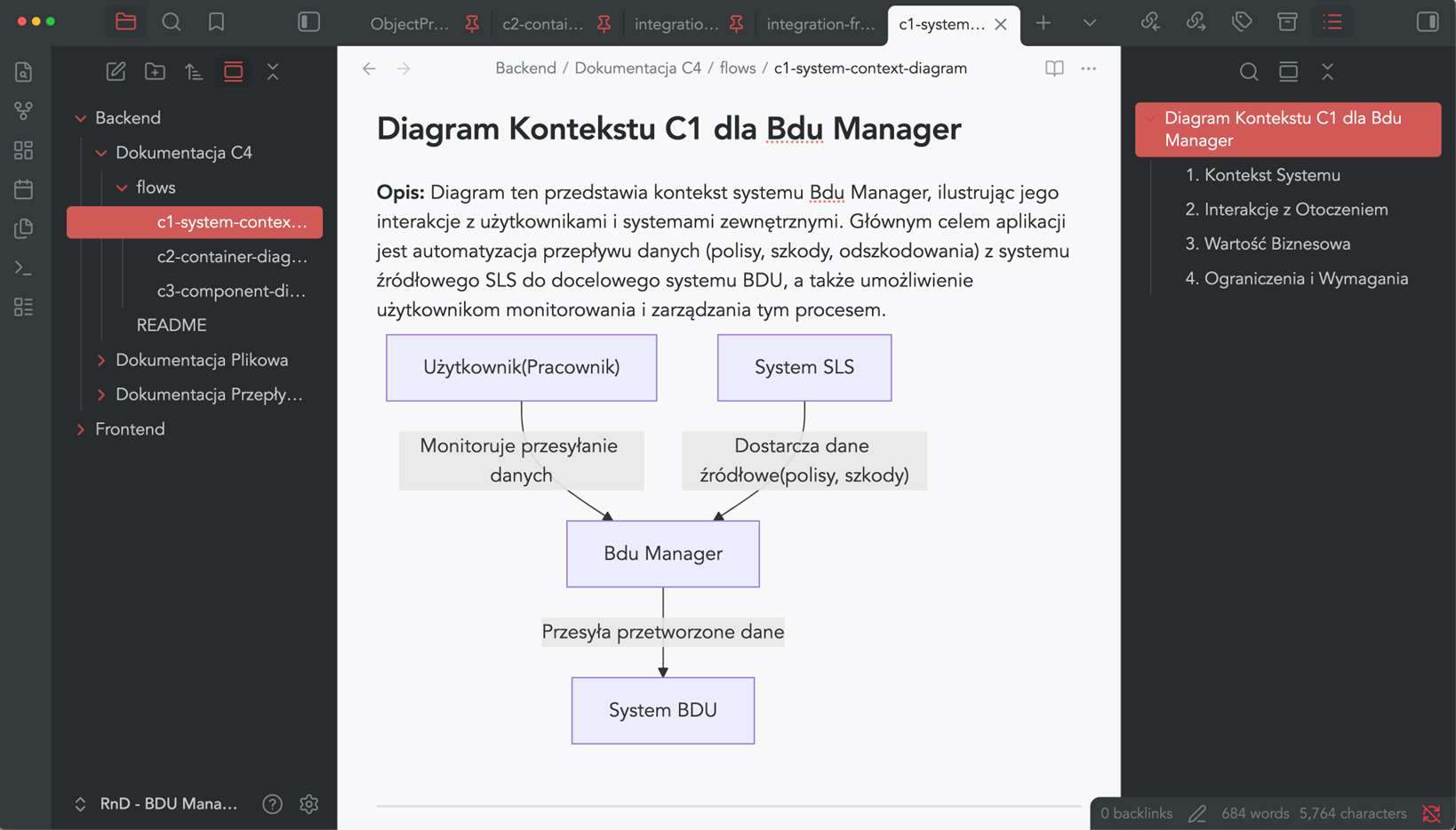
Architectural visualisation of C4 & Mermaid
Architectural documentation in accordance with the C4 model
S*.doc automatically generates Mermaid diagrams for the context, container and component views – in accordance with the widely recognised C4 model.
So, no more manually drawing diagrams that become outdated after the first sprint.
- Consistent visual representation of the architecture at various levels of detail
- A clear presentation for the board, auditors and new team members
Business Process Mapping (BPM)
Business process documentation
S*.doc models the flows within the system and how its components interact – process steps, interdependencies between components, and data exchange points.
Instead of asking, “How does it work with other things?” – you can check it out in 30 seconds.
- Visualisation of user journeys and communication between services
- A description of the internal logic in language that is understandable to both business and technical staff
- Support for retrospective code reviews and dependency analysis