When the System „Works” but Costs a Fortune: The Legacy Debt in Insurance
Recently, our CEO Radosław Bzoma shared his insights in the „Gazeta Ubezpieczeniowa” regarding the hidden traps of digital transformation. In particular, he addressed a paradox that many boards face today: the illusion of a functioning system. According to his analysis, legacy systems rarely fail spectacularly. Instead, they gradually erode an organization’s ability to compete. This happens at a pace too slow to raise an alarm. However, it is still too fast to ignore.
The Case of a 550,000 Policy Portfolio
Consider, for example, an insurance company with a portfolio of over 550,000 motor policies. Their core system, dating back to 2009, was stable, fully depreciated, and well-known to the IT team. For this reason, its predictability was seen as a major asset for many years.
However, the turning point came unexpectedly. A competing firm launched a similar product for the same market. Consequently, before the commissioned organization had even finished evaluating the integration project, the contract had already been signed with someone else.
Furthermore, an audit of the last four years revealed a systematic pattern: a continuous loss of business opportunities in situations where IT response time was the decisive factor. Ultimately, this event forced the company to ask the key question: how much does the current system actually cost us?
The „Free” System That Costs Millions
As it turns out, the audit yielded unsatisfactory results. The annual cost — taking into account maintenance, regulatory compliance, and delays in the implementation of new products — was estimated at approximately 3.8 million PLN.
In addition to these figures, there were incalculable, irretrievably lost business opportunities. Even though the system was formally decommissioned, it still generated significant indirect costs. Ultimately, “free of charge” turned out to be merely a bookkeeping perspective, as it failed to reflect the true impact on the business.
When Does a System Become Obsolete?
In fact, a system becomes obsolete not because of its age, but at the moment when its limitations and costs outweigh its benefits. While the cost of modernization is rising, this is just a warning sign rather than a final verdict.
To help you identify this stage, here are 5 signs it’s time to modernize:
- First, Regulatory Paralysis: Specifically, every regulatory change requires a multi-month IT project.
- Second, Integration Blocks: The lack of an API layer blocks integration with both internal and external partners.
- Furthermore, Knowledge Gaps: System knowledge is concentrated in only one or two people, creating a significant risk.
- Moreover, Slow Speed-to-Market: You deploy new products slower than the competition due to technical constraints.
- Finally, Technical Debt: This occurs when technical debt is growing faster than the overall IT budget.
Strategic Paths for IT Transformation
The decision on which path to choose should be based on data, not intuition. An audit of hidden costs can be completed in four to six weeks before any major commitments are made.
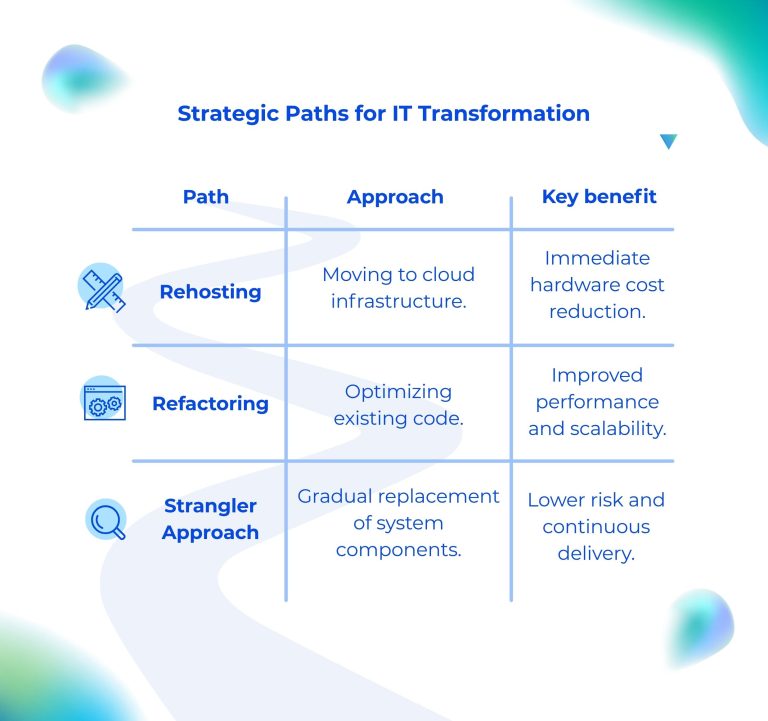
The company described here adopted the Strangler approach. The measurable results achieved include:
- Tariff Change Speed: Reduced from several months to two or three days.
- Cost Efficiency: IT costs have fallen by 34%.
- Strategic Growth: Launched integrations with internal partners that were previously out of reach.
Myth: „If It Works, Don’t Fix It”
Indeed, this is one of the most costly simplifications in the insurance industry. Systems rarely fail spectacularly; instead, they gradually erode the ability to compete.
Therefore, the key question is not: „Does our system work?” Rather, the question is: „How much does it cost us that it works exactly this way?”
If you don’t know the answer, then that’s precisely the right moment to start looking for it.
Legacy Documentation Automation
Knowledge about your
system architecture can update itself
Knowledge about your
system architecture can update itself
Instead of manually rewriting code structures and wasting time in Confluence, implement S*.doc.
Our AI agents automatically map your application architecture, while your team gets a RAG bot integrated with Microsoft Teams that can answer any question about the system directly from the source code.
Automatic generation of Java/C# documentation
Code documentation
Generated automatically, taking into account the specific features of the programming language – Java, C#, TypeScript, C++. It divides the content into logical sections, omits irrelevant elements and allows you to tailor the type of documentation to the audience: technical for developers or simplified for end users.
- A clear, structured description of each module
- Automatic skipping of boilerplate and generated code
- The ability to generate a report on compliance with safety guidelines or a report on technological optimisation
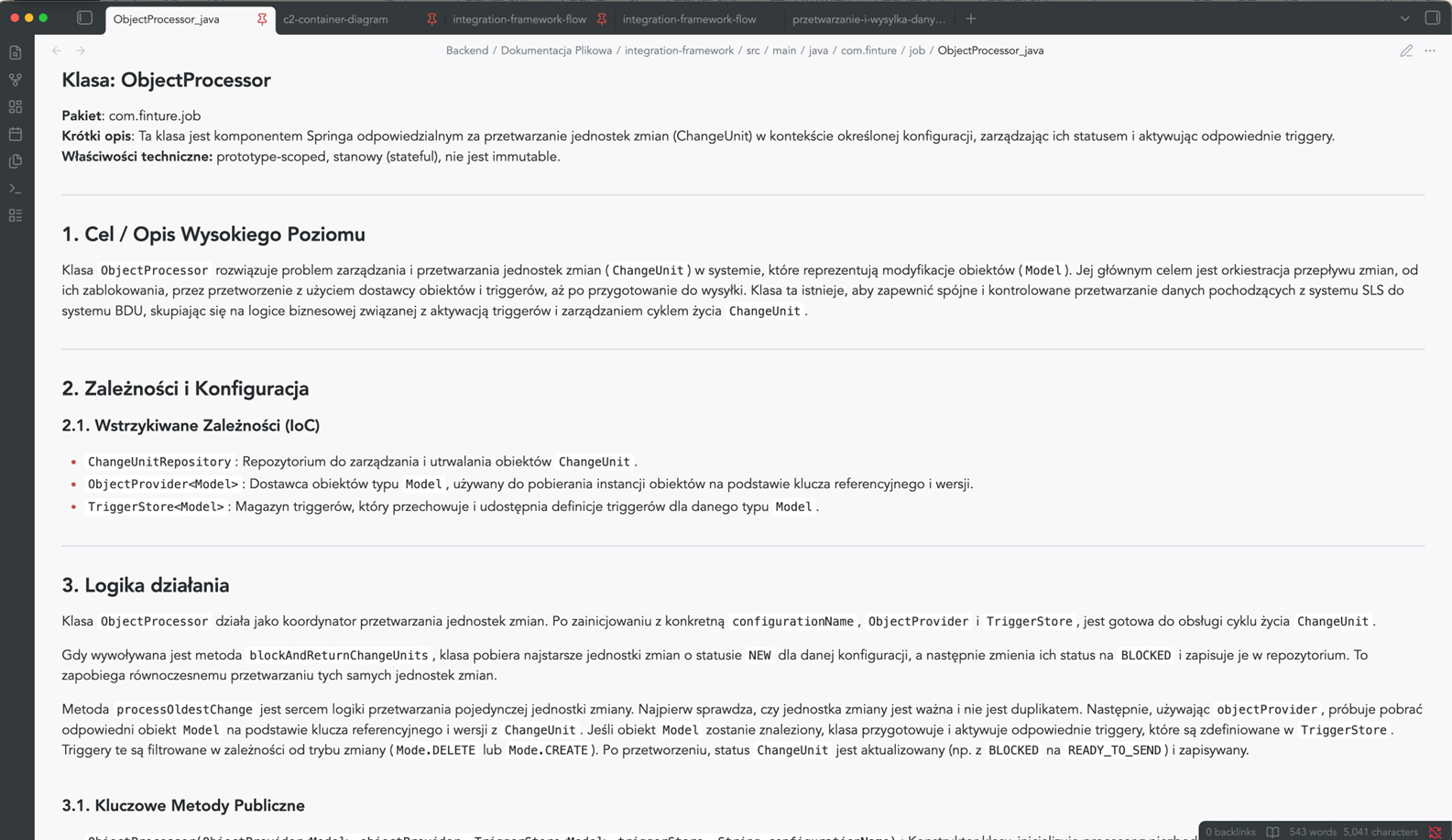
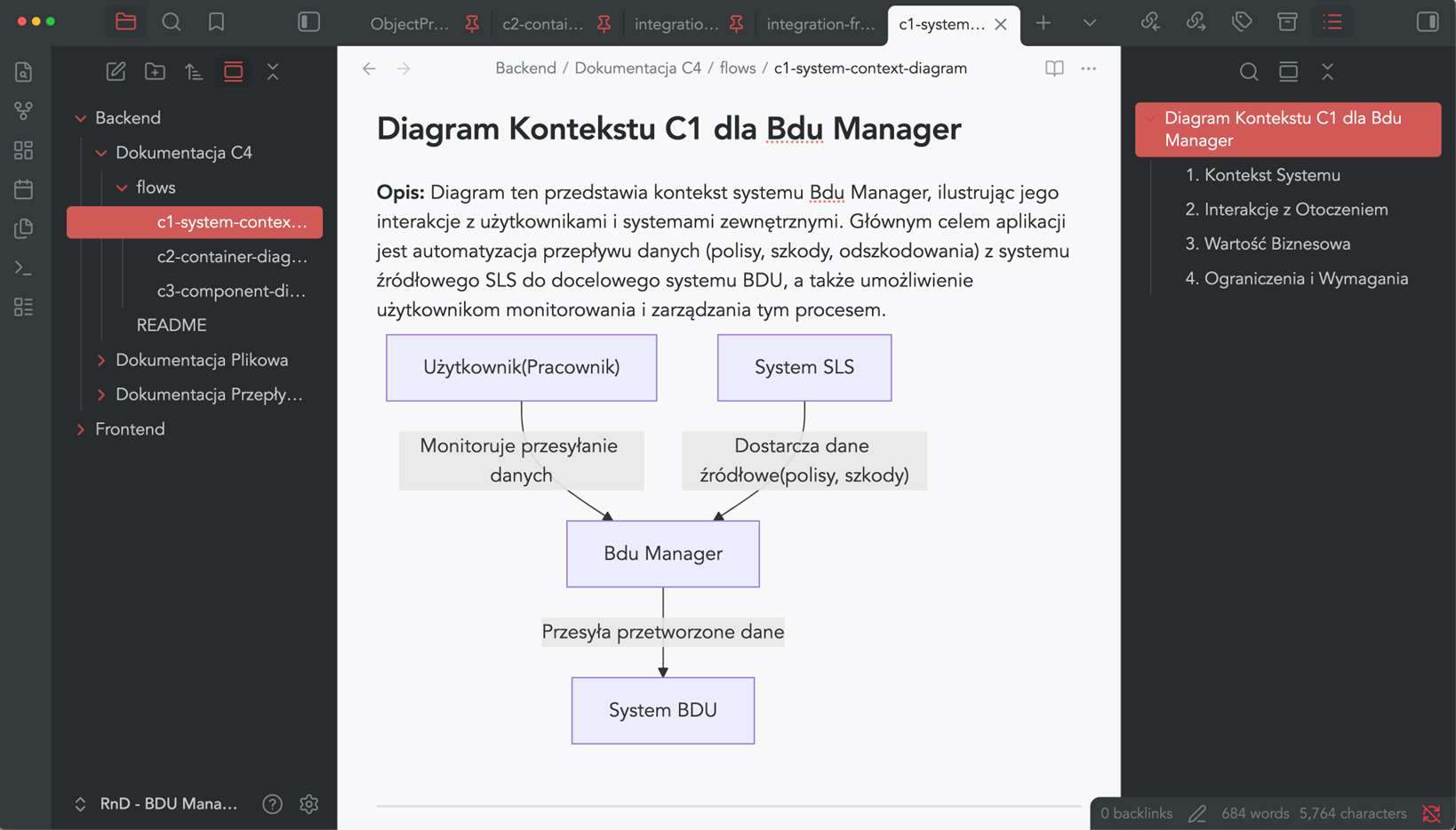
Architectural visualisation of C4 & Mermaid
Architectural documentation in accordance with the C4 model
S*.doc automatically generates Mermaid diagrams for the context, container and component views – in accordance with the widely recognised C4 model.
So, no more manually drawing diagrams that become outdated after the first sprint.
- Consistent visual representation of the architecture at various levels of detail
- A clear presentation for the board, auditors and new team members
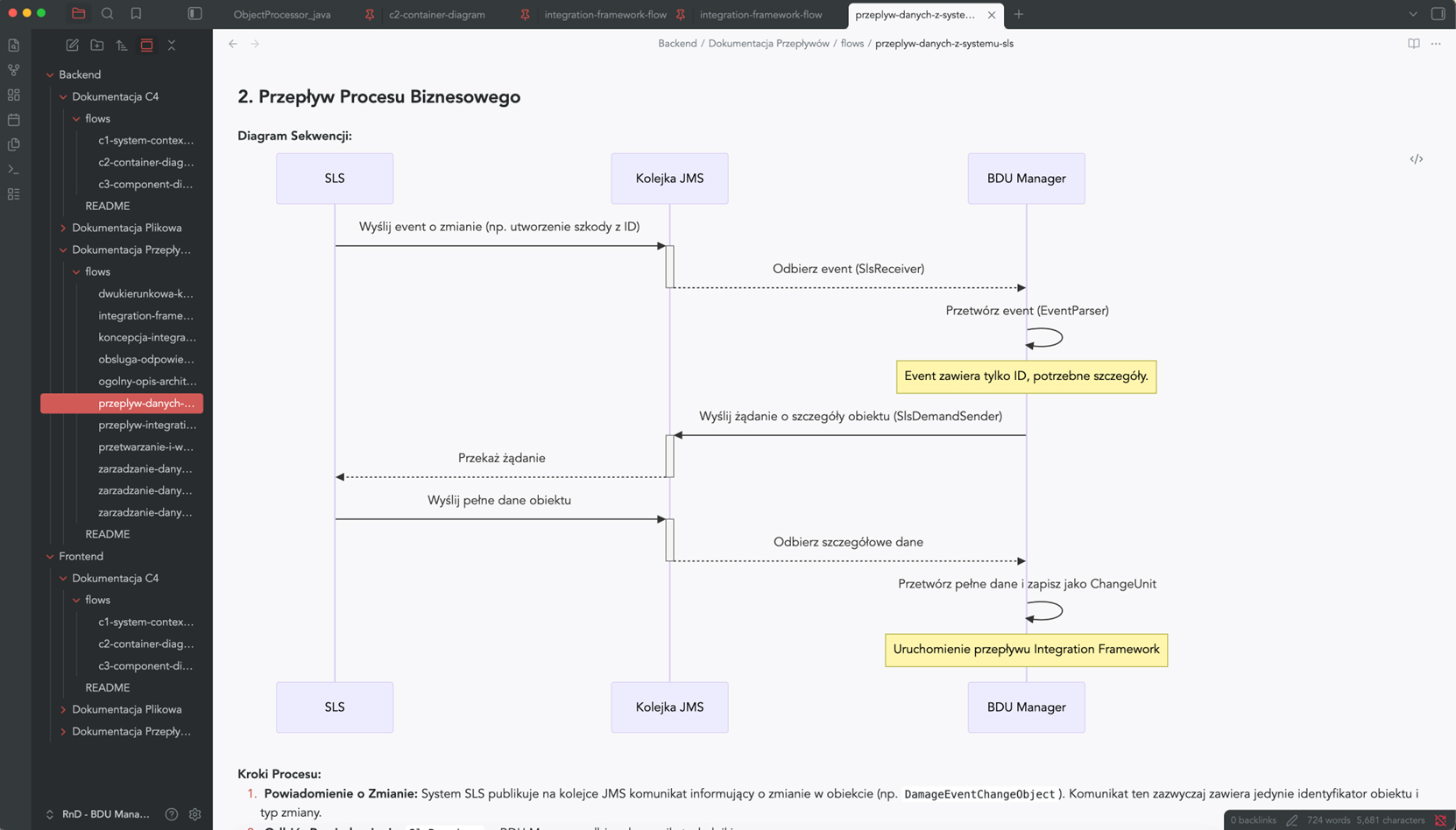
Business Process Mapping (BPM)
Business process documentation
S*.doc models the flows within the system and how its components interact – process steps, interdependencies between components, and data exchange points.
Instead of asking, “How does it work with other things?” – you can check it out in 30 seconds.
- Visualisation of user journeys and communication between services
- A description of the internal logic in language that is understandable to both business and technical staff
- Support for retrospective code reviews and dependency analysis
Automatic generation of Java/C# documentation
Code documentation
Generated automatically, taking into account the specific features of the programming language – Java, C#, TypeScript, C++. It divides the content into logical sections, omits irrelevant elements and allows you to tailor the type of documentation to the audience: technical for developers or simplified for end users.
- A clear, structured description of each module
- Automatic skipping of boilerplate and generated code
- The ability to generate a report on compliance with safety guidelines or a report on technological optimisation
Architectural visualisation of C4 & Mermaid
Architectural documentation in accordance with the C4 model
S*.doc automatically generates Mermaid diagrams for the context, container and component views – in accordance with the widely recognised C4 model.
So, no more manually drawing diagrams that become outdated after the first sprint.
- Consistent visual representation of the architecture at various levels of detail
- A clear presentation for the board, auditors and new team members
Business Process Mapping (BPM)
Business process documentation
S*.doc models the flows within the system and how its components interact – process steps, interdependencies between components, and data exchange points.
Instead of asking, “How does it work with other things?” – you can check it out in 30 seconds.
- Visualisation of user journeys and communication between services
- A description of the internal logic in language that is understandable to both business and technical staff
- Support for retrospective code reviews and dependency analysis