
Analyst’s Perspective
3 Questions for the Expert. Izabela Czaplejewicz
Delivering banking projects often involves unexpected challenges – but also positive surprises. Izabela Czaplejewicz, a business and systems analyst with extensive experience in large financial institutions, shares insights into the realities of her work and what helps – or hinders – effective collaboration with clients.
Iza highlights situations where clients impress with their preparation and deep understanding of their own processes. At the same time, she points out areas where organizations need to improve communication and decision-making. She emphasizes the importance of clearly defined responsibilities and explains why their absence is often the biggest barrier to improving banking processes.
What are 3 things that have positively surprised you in working with clients as an analyst?
- It’s always a pleasant surprise when a client knows what they want 😊 That means they have clearly defined requirements, analyzed them internally, and discussed them with all relevant departments involved in or impacted by the project.
- Another positive surprise is when the client understands their systems – where data comes from, how it flows, etc. This is especially valuable in large organizations with complex architectures and multiple systems, applications, and databases.
- And last but not least – a clear division of roles and responsibilities. This always improves collaboration and accelerates project delivery.
What are 3 things clients could do better?
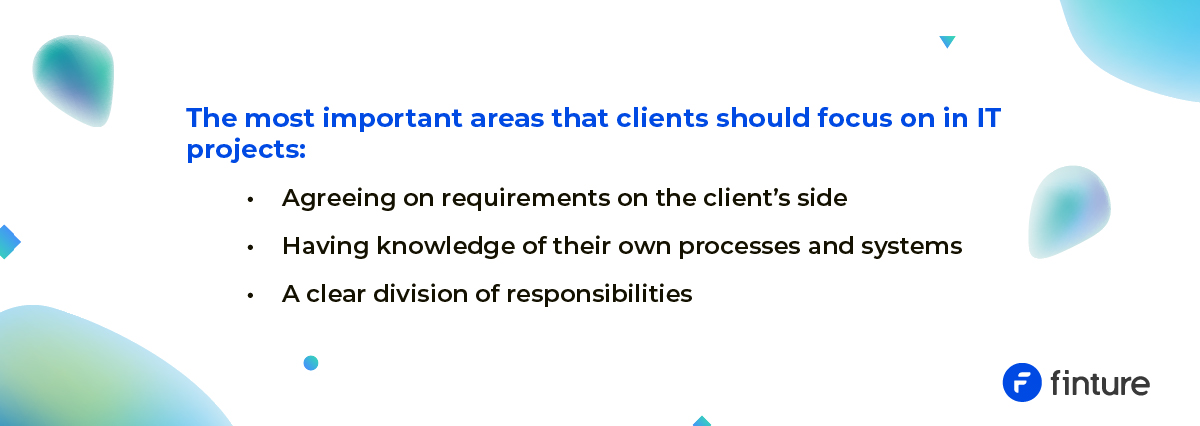
- Aligning requirements internally – unfortunately, projects are often driven by a single business unit, while dependencies with other areas are overlooked during the initial analysis. These issues tend to surface later in the project – sometimes just before implementation – when changes are far more time-consuming, costly, and risky (including the risk of regression, where previously working elements stop functioning 😉).
- Understanding their own processes and systems. It still happens that clients don’t fully understand what exists within their systems. The approach can be quite general – “it works somehow, but we don’t really know how.”
- Unsurprisingly, a lack of clear ownership and accountability is a recurring issue. In some organizations, accountability is blurred, or individuals assigned to the project are not decision-makers. This not only extends project timelines but can also completely block progress.
What is the most challenging aspect of working on banking processes?
If I had to choose one, it would be unclear accountability combined with centralized decision-making. Organizations often assign specialists to projects, while decisions remain with managers. These managers typically handle many other responsibilities and don’t always have the time to focus on project-related matters.
This is what frustrates teams the most. Work comes to a halt due to a lack of directional decisions – even on issues that may not seem strategic but are critical for project delivery.